
Dihexa: A Peptide Modulator of Synaptic Plasticity and Neural Regeneration

Simplified Summary
Dihexa is a small, lab-designed protein fragment (peptide) created for scientific research into brain repair, learning, and memory. In simple terms, Dihexa acts like a molecular “boost” for neural connections. It’s synthetic, meaning it isn’t found naturally in the body – instead, scientists engineered it based on a short hormone fragment (angiotensin IV) to better penetrate the brain and last longer. Early laboratory studies in cells and animals suggest Dihexa can enhance synaptic plasticity, which is the brain’s ability to form and reorganize connections between neurons. For example, experiments indicate Dihexa might increase the number of synapses (the communication links between brain cells) and encourage the growth of new neuronal branches, potentially by turning up certain growth signals in the brain. It appears to influence neurotrophic pathways – in particular, it partners with a natural brain growth factor called HGF to activate the c-Met receptor, a pathway involved in cell growth and survival. By doing so, Dihexa has shown effects like improved learning in memory-impaired rats and more robust neural networks in tissue studies. Importantly, all these findings come from preclinical research (laboratory and animal studies) only. Dihexa is strictly an experimental compound not approved or intended for human use. Scientists study it to understand how tiny peptides can potentially rebuild neural connections and support brain regeneration, helping us learn how the brain might maintain cognitive resilience.
Introduction
Peptide bioregulators and synthetic neuroactive peptides are a growing frontier in biomedicine. These are very short chains of amino acids (the building blocks of proteins) that can send biological signals to cells. Natural peptide bioregulators (like those from the thymus or pineal gland) have been studied for their ability to modulate organ function and gene activity in specific tissues. Dihexa represents a new twist on this concept: it is a hexapeptide derivative of a brain hormone fragment, deliberately engineered by scientists to probe mechanisms of neuroplasticity and brain repair. First identified by researchers at Washington State University, Dihexa originated from efforts to improve on angiotensin IV, a naturally occurring peptide hormone fragment that had hinted at cognitive effects. By modifying Ang IV’s structure to be more brain-accessible and long-lasting, scientists created Dihexa as a tool to enhance synaptic connectivity and cognitive processes in preclinical models. In other words, Dihexa is designed to mimic and amplify the brain’s own growth signals, providing a window into how boosting certain pathways might improve learning and memory.
The rationale behind developing small peptide analogs like Dihexa comes from a desire to study neuroplasticity and neuronal repair at the molecular level. Traditional neurological drugs often target neurotransmitters or symptoms, but peptides like Dihexa work upstream, nudging the cell’s own growth and survival programs. By creating an analog of a natural signaling molecule (Ang IV), researchers aimed to trigger pathways involved in memory formation, synapse development, and neuron regeneration more powerfully than the original hormone fragment could. Dihexa specifically was designed to engage the hepatocyte growth factor (HGF)/c-Met system – a pathway known for its role in cell growth and healing – to see how activating this system affects brain cells. It is important to note that Dihexa remains only a research compound: all investigations so far have been limited to cell cultures and animal models. Scientists utilize Dihexa in the laboratory to explore HGF/c-Met pathway modulation and to deepen our understanding of neuronal communication, synaptic plasticity, and the brain’s capacity for self-repair.
Molecular Origin & Structural Characteristics
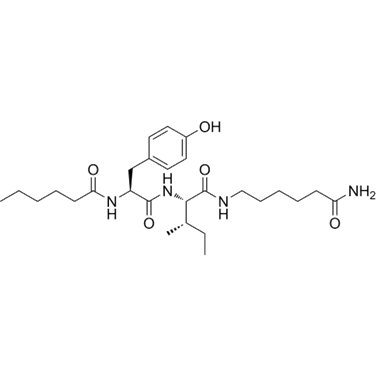
Dihexa’s chemical identity is that of a modified hexapeptide derived from angiotensin IV. In chemical terms, it is often described as N-hexanoic-Tyr-Ile-(6)HomoPhe-His-Leu (with the full name being N-(1-oxohexyl)-Tyrosyl-(6-aminohexanoic)-Isoleucinamide). This jargon means that the peptide’s backbone is based on a short chain of six amino acids, but with strategic modifications: a fatty acid chain (hexanoic acid) is attached to one end, and one of the amino acids is a special variant (homophenylalanine) not found in the original hormone sequence. These tweaks were intentional – by adding the hexanoyl group and using an amino acid analog, the molecule became more lipophilic (fat-loving) and less prone to degradation by enzymes. The result is a peptide that can survive longer in the bloodstream and cross the blood–brain barrier more effectively than Ang IV itself, which is rapidly broken down and normally doesn’t enter the brain well. Dihexa’s small size (molecular weight on the order of only a few hundred daltons, ~500 Da) and these lipophilic modifications allow it to slip through biological membranes and reach brain tissue in animal studies.
One of the most notable structural features of Dihexa is its ability to bind with high affinity to hepatocyte growth factor (HGF). HGF is a large protein growth factor, and its receptor is a protein on cell surfaces called c-Met. Normally, HGF fits into c-Met to activate a cascade of signals that promote cell growth, differentiation, and survival. Dihexa, despite being tiny compared to HGF, can attach to HGF in a way that “supercharges” its activity at the c-Met receptor. In essence, Dihexa acts like a molecular key that turns the lock of the c-Met receptor more efficiently. Structurally, by binding to HGF, Dihexa helps HGF form an active complex that triggers c-Met. This is remarkable – it means an engineered mini-peptide can hijack a major cell-growth pathway. The design of Dihexa took inspiration from naturally occurring peptides (like Pinealon or Testagen, which are tissue-derived regulators), yet Dihexa is fully synthetic and purpose-built. It’s an example of rational drug design merging with peptide biology: researchers identified a beneficial natural pathway (HGF/c-Met for neural growth) and crafted a peptide analog to mimic and enhance that pathway beyond what the body’s normal peptides do.
Physicochemically, Dihexa highlights the advantages of small peptides in therapeutics research. It has a low molecular weight and a structure stabilized against peptidases (the enzymes that typically digest peptides). Studies found that Dihexa is remarkably stable in the body of test animals, with a half-life on the order of days, not minutes. Its lipophilicity means it can travel through the normally restrictive blood–brain barrier, delivering its effects directly to the central nervous system. Unlike large protein growth factors, which might be too big or fragile to use in the brain, Dihexa’s compact form factor allows it to act as a surrogate neurotrophic signal. In summary, Dihexa’s molecular design bridges neurotrophic biology and synthetic chemistry: it is essentially a miniaturized, brain-penetrant growth factor mimetic. This exemplifies a new generation of peptides engineered to carry specific bioactivities – in Dihexa’s case, the ability to engage neural repair and connectivity pathways with precision.